Sunday, October 9, 2022

The Advancement of Technology and Culture


The impact of technology on culture and how it effects, and influences society is undeniably substantial. Values, norms, and practices are the culture of society and “technology has a crucial impact on fundamental aspects of all our cultures” (Niroula, 2018). The interactive relationship between the advancement of technology and culture is rooted in recurrent co-dependency. Strengthening interpersonal connections is the vital role that technology plays in culture where people tend to devote more time to technology and less time in social environments (Niroula, 2018).

Below is a really good video called How Does Technology Impact Our Culture posted by V. Mathew (2016) that gives a good and brief explanation on how technology impacts our culture.


References

Matthew, V. (2016, November 19). How Does Technology Impact Our Culture? [Video]. YouTube. Retrieved from https://www.youtube.com/watch?v=yWnjEcX-614

Niroula, A. (2018, March 21). Impacts of Technology on Culture, Tradition and Social Values. LinkedIn. Retrieved from https://www.linkedin.com/pulse/impacts-technology-culture-tradition-social-values-ashes-niroula


The Advancement of Technology and Society's Expectation


Over the years, the advancement of technology in mass media has changed society’s expectations. Society have gone from face-to-face communication and interactions to text messaging and instant messages. People no longer go out to the movies but stay home and stream movies. The way that society interacts with each other has been dramatically altered (Society’s Expectations of Technology, 2021).

Author and Psychologist Sherry Turkle has studied society’s relationship to technology for over a decade and shared in her Tedtalk, “Connected, but Alone?” (2012) shared about how dependent society has become on technology. She talks about how in just a short period of time, technology has made communication more convenient at the expense of human interaction. She asks that “as [society] expects more from technology, do we expect less from each other?” (Tedtalks, 2012).


References

Society’s Expectation of Technology. (2021, November 27). Society’s Expectations of Technology: Building a Relationship with Technology and Losing Relationships with Each Other[blog]. Technology, Media, and Culture. Retrieved from https://techmedculture.blogspot.com/2021/11/societys-expectations-of-technology.html

Tedtalks: Sherry Turkle--Connected, But Alone? (2012). YouTube. Retrieved from https://www.ted.com/talks/sherry_turkle_connected_but_alone.

Technology Advancement in Mass Media

There are many layers to the evolution of technological advancement in mass media. Merriam-Webster dictionary (n.d.) defines mass media as “communication such as newspapers, radio, or television that is designed to reach the mass of people”. And thanks to technology, modes of communication can include the internet and social media. The photo below outlines a broad overview of the evolution that media or modes of communication have undergone over the years.

Advancements in Technology (2013) is an excellent video that shows just how much technology has evolved since the 1900’s. It shows the different modes of communication that were once prevalent in communicating to the masses. Nowadays, in the field of communication, professionals can produce content faster than they ever did before technology (Anderson, 2016). And these technological advancements are also what was needed to enable communication globally with much more ease and efficiency.


References

Anderson, N. (2016, July 10). Technology's Advancement in Mass Media [blog]. Technology's Advancement in Mass Media. Retrieved from https://nicoleanderson12.blogspot.com/2016/07/technologys-advancement-in-mass-media_10.html

Khan, H. (2013, May 13). Advancements In Technology. Retrieved from https://www.youtube.com/watch?v=HuCOThqyRx0

Merriam-Webster. (n.d.). Mass medium. In Merriam-Webster.com dictionary.                Retrieved from https://www.merriam-webster.com/dictionary/mass%20medium


Sunday, September 25, 2022

The Future of Technology


It is clear that the development of technology is continuous. And while no one can predict the future with absolute certainty about which way technology trends will go or how it will affect the workplace, there are reasonable arguments being made. Some futurists claim that “the rate of technological progress is accelerating” and that “better tools help us create better tools” (Anissimov, 2022). 

Some future technological developments will undoubtedly require futuristic training. Areas of development that are being anticipated are biotechnology, nanotechnology, robotics, the domain of computers increasing in functionality, and automation technology (Annissimov, 2022). These developments can affect how the field of communication operates in the future. For example, someday Machine to Machine communication might enable artificial intelligence (AI) and machine learning to exchange information, a technology that can be used for remote working and data usage management (Perrin, 2021). 

References

Anissimov, M. (2022, September 13). What is the Future of Technology? All the Science. Retrieved from https://www.allthescience.org/what-is-the-future-of-technology.htm#:~:text=No%20one%20can%20predict%20the%20future%20of%20technology,continue%20to%20get%20more%20powerful%2C%20numerous%2C%20and%20cheaper.

Perrin, A. (2022, August 31). Future Communication Technology: Changes You Can't Ignore [blog]. Adapt IT Telecoms. Retrieved from https://telecoms.adaptit.tech/blog/future-communication-technology/  


Public Relations and Technology


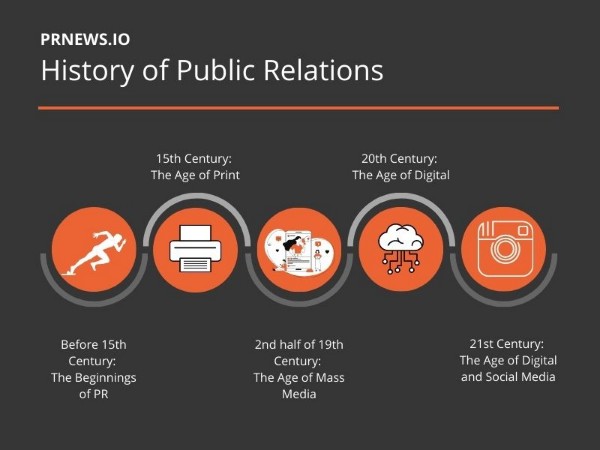
Public Relations (PR) is a field of communication that has had to evolve with changes in technology. The history of public relations dates back to before the 15th century and has been divided into four ages: the Beginnings of PR, the Age of Print, the Age of Mass Media, and the Age of Digital and Social Media (Nartya, 2022). The field of public relations work closely with other professional areas of communication such as journalism and marketing. Public relations representatives, sometimes referred to as Public Information Officers (PIOs), provide useful information and insight and are often spokespersons for organizations, governmental agencies, celebrities, etc. (Kolodzy, 2012, p. 29). 

And just like journalism and marketing, PIOs have had to make training a priority to keep up with the constant evolution of technology. PR is far more than just managing relationships between organizations and the public, it also involves a strategic approach to utilizing digital technologies (Moyer, 2015). PR professionals have gone from creating content by hand and then handing out hardcopies, mailing, faxing, or sending it by telegraph to now producing documents on a computer or mobile device and posting them to social media or sending via e-mail and/or posting on their website and their technological access continues to evolve. “Much of the strategy and tactics of public relations rely on the use of media…and are designed to improve effectiveness and efficiency” (Moyer, 2015).


References

Kolodzy, J. (2012). Practicing Convergence Journalism. Taylor & Francis. https://bookshelf.vitalsource.com/books/9781136222825

Moyer, J. (2015, June 3). Mapping the Consequences of Technology on Public Relations. Institute for Public Relations. Retrieved from https://instituteforpr.org/mapping-technology-consequences/#:~:text=Technology%20has%20long%20influenced%20how%20public%20relations%20practitioners,electronically%20transmitted%20press%20release%20on%20March%208%2C%201954.

Nartya, D. (2022, January 26). History of Public Relations. PRNEWS Blog. Retrieved from https://prnews.io/blog/history-of-public-relations.html



Technology


For many years, various forms of communication have changed how we interact with other. Almost 90% of communication nowadays is utilized by some form of digital methods (Ronald, 2021). And the evolution of technology has prompted modern-day communicators to reconsider how they do their work. The workplace went from face-to-face communications to webinars and virtual meetings. The diversity of modes of communication has affected productivity, workplace interaction, how work is created, shared, and tracked, and it is constantly changing (Asset Panda, 2021). 

Professional training is also influenced by the evolution of technology. Organizations started initiating training and development through technology-based methods in the 1980’s (Beach, 2018). Businesses realized the need to keep their employees abreast of technology changes and skills. They understood that there was value and an advantage to providing the technological training. It was cost efficient, effective, and contributed to the company’s goals (Beach, 2018). Therefore, an organizations proactive approach to technological training has been a win-win for employees as well as the organization. 

References

Asset Panda. (2021, October 6). The History of Communication in the Workplace [blog]. Asset Panda. Retrieved from https://www.assetpanda.com/resource-center/blog/the-history-of-communication-in-the-workplace/

Beach, D. (2018, March 7). The Impact of Technology on Employee Training. LinkedIn. Retrieved from https://www.linkedin.com/pulse/impact-technology-employee-training-david-beach

Ronald. (2021, November 30). The Role of Technology in the Evolution of Communication. Genuinereviews. Retrieved from https://genuinereviews.org/technology-in-the-evolution-of-communication/#:~:text=The%20Internet%20Undoubtedly%2C%20since%20the%20middle%20of%201990s%2C,internet%20has%20totally%20transformed%20communication%20in%20every%20way.


Annotated Bibliography

Anissimov, M. (2022, September 13). What is the Future of Technology? All the Science. Retrieved from https://www.allthescience.org/what-is...